Your Safety Starts Before Your Appointment: My Commitment to Clean Instruments and Responsible Foot Care
Welcome to Sacred Musings, a space where I share reflections from the heart on love, life, caregiving, and the lessons that shape us into who we are. My hope is that these words bring comfort, perspective, and inspiration to anyone walking their own path of healing and growth.
When you book foot and nail care, you may think about comfort, healthier-looking nails, or finally getting help with feet that have become difficult to manage.
As a nurse, I also think about everything that happens before you arrive.
How are the instruments cleaned? How are they sterilized? How are they protected until your appointment?
At Sacred Heart Nursing Services, these questions are part of the foundation of care. You deserve to understand how the instruments touching your feet are prepared and why that matters.
Why I Invested in an Autoclave
I invested in a Class B steam autoclave to process compatible reusable foot and nail instruments.
An autoclave uses steam under pressure, at a specified temperature and for a specified time, to achieve sterilization. Properly performed steam sterilization destroys microorganisms, including resistant bacterial spores. Its effectiveness depends on correct preparation, loading, operation, and monitoring. (cdc.gov)
That investment reflects my belief that the preparation behind an appointment deserves the same attention as the care provided during it.
How Does Nursing Foot Care Compare With a Nail Salon Pedicure?
Both services can help people enjoy well-maintained nails and more comfortable feet. The main differences are the purpose of the appointment, the provider’s training, and the assessment that guides the care.
A traditional salon pedicure generally emphasizes grooming, appearance, and relaxation. At Sacred Heart Nursing Services, my approach centers on foot health, non-invasive maintenance, and your individual nursing needs.
What you can expect
Traditional nail salon pedicure
Sacred Heart Nursing Services
Primary focus
(T) Cosmetic nail care, grooming, and relaxation
(S) Foot health, comfort, preventive education, and maintenance
Provider
(T) A licensed manicurist or cosmetologist
(S) A registered nurse providing care within nursing scope and competence
Assessment
(T) Consultation about the requested cosmetic service and suitability
(S) Review of relevant health history and assessment of skin, nails, and concerns that may affect care
Service planning
(T) Shaped by the requested pedicure and cosmetic preferences
(S) Shaped by assessment findings, health considerations, and what can safely be provided
Instrument processing
(T) California requires cleaning and disinfection of reusable tools; compliant sterilization is also permitted
(S) I use a steam autoclave to sterilize compatible reusable foot and nail instruments
Education and follow-up
(T) Varies by provider
(S) Individualized foot-care education, nursing documentation, and referral when concerns require another healthcare professional
California salons have specific health and safety obligations. For many reusable non-electrical tools, the state requires cleaning, drying, and immersion in an appropriate EPA-registered disinfectant. Its regulations also recognize sterilization as an alternative when the specified requirements are met. Some salons choose to use autoclaves. (barbercosmo.ca.gov)
Disinfection and sterilization are different processes. Disinfection targets many harmful microorganisms. Sterilization destroys all forms of microbial life, including bacterial spores, when the process is performed correctly. My investment in autoclave processing is one part of my commitment to infection prevention. (cdc.gov)
Why the Nursing Approach Matters
You may want help because reaching your feet has become difficult, your nails have thickened, or changes in your health have made routine foot care more complicated.
As a nurse, I consider those circumstances when planning your care. My responsibility includes assessing your needs, recognizing concerns, providing appropriate education, and identifying when referral is necessary. These responsibilities are grounded in California’s nursing standards. (rn.ca.gov)
For you, that means an appointment guided by your health as well as your comfort. It also means having someone explain what they see, discuss what can safely be done, and help you understand the next step.
Nursing foot care complements podiatry and other healthcare services. An open wound, suspected infection, or another concerning finding may require medical evaluation before routine care proceeds.
Whether you choose a salon pedicure or nursing foot care, you deserve respectful service, appropriate infection prevention, and clear answers to your questions.
At Sacred Heart Nursing Services, I bring my nursing knowledge, careful instrument preparation, and commitment to education into every appointment because your feet carry you through life, and they deserve thoughtful care.
The Process Begins With Cleaning
Sterilization is a sequence of careful steps.
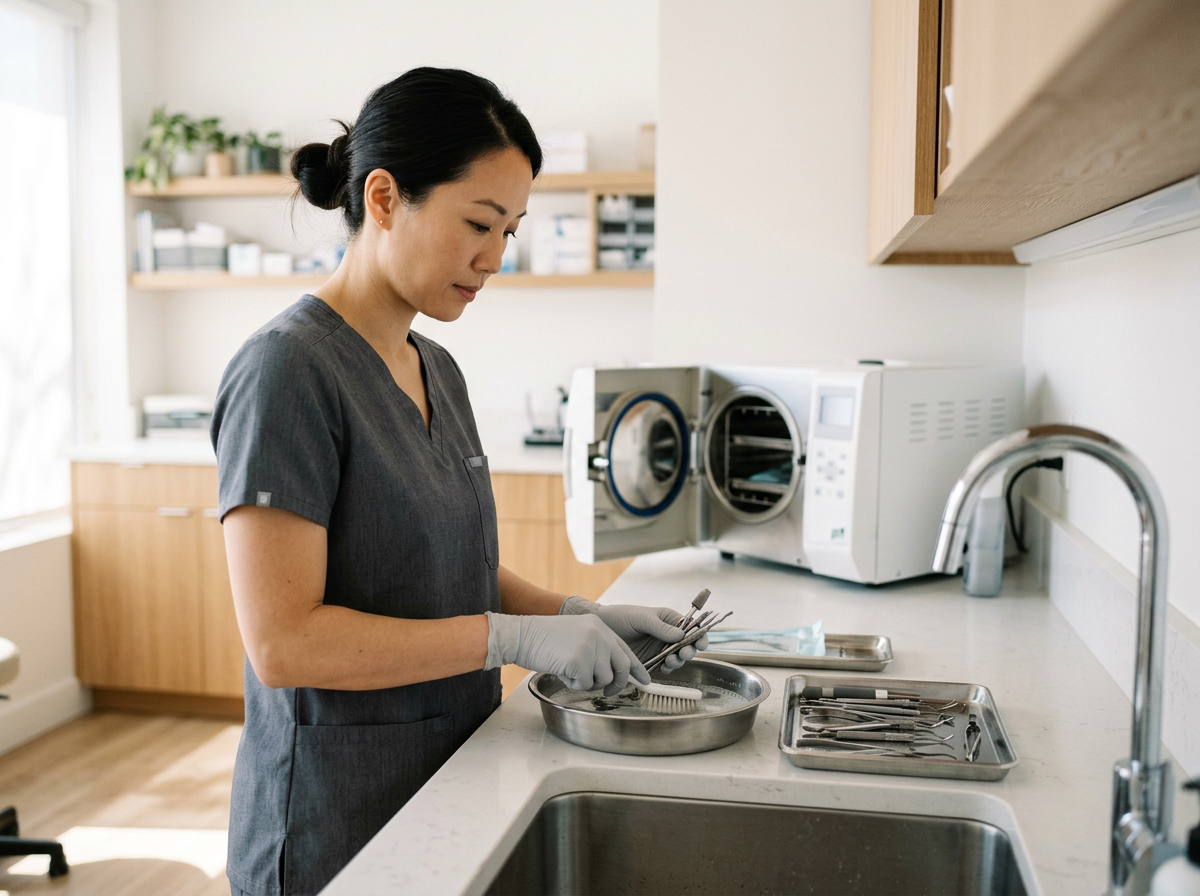
My instrument-processing workflow keeps used instruments separate from clean instruments and moves from a designated dirty area toward a clean area.
Reusable instruments are thoroughly cleaned with compatible instrument-cleaning products and equipment. An ultrasonic cleaner helps remove debris from difficult-to-reach areas, but ultrasonic cleaning itself does not sterilize instruments. Cleaning must happen before sterilization because remaining debris can interfere with the process. (cdc.gov)
After cleaning, instruments are rinsed, dried, inspected,and packaged appropriately for steam sterilization. Compatible instruments then undergo the cycle specified by the equipment and instrument manufacturers.
After processing, packages must remain dry, intact, and protected until use. Every stage matters, from handling a used instrument to opening a properly processed package for the next client.
Owning an Autoclave Is Only Part of the Responsibility
A dependable sterilization program also requires checking that the process is working.
CDC guidance describes three complementary types of monitoring:
Mechanical monitoring: reviewing cycle information such as time, temperature, and pressure.
Chemical monitoring: using indicators that respond to specified processing conditions.
Biological monitoring: using resistant spores to assess the sterilization process.
A color-changing indicator alone does not establish that an instrument is sterile. Monitoring, equipment maintenance, and documentation all support a reliable process. (cdc.gov)
These are the standards of accountability I believe should be built into nursing foot care.
My Responsibility as a California Registered Nurse
My nursing responsibilities follow me into every setting where I provide care.
California’s Nursing Practice Act establishes the legal framework for registered nursing practice. The Board of Registered Nursing’s Standards of Competent Performance address assessment, care planning, competent care, evaluation, and client advocacy. (rn.ca.gov, rn.ca.gov)
At Sacred Heart Nursing Services, I take those responsibilities seriously. My commitment is to follow applicable California requirements, work within my education and competence, and use established infection-prevention guidance and manufacturers’ instructions.
California nursing requirements and CDC recommendations serve different purposes. Together, they help inform responsible practice; CDC recommendations should not be presented as a separate California foot-care nursing law.
What This Means for You
For consumers, careful instrument processing helps reduce the risk of transferring microorganisms between clients. It is one important layer of protection alongside hand hygiene, appropriate protective equipment, and a properly maintained care environment. (cdc.gov)
You also benefit from nursing judgment: someone who considers your health history, assesses your feet, explains the care being provided, and recognizes when a concern needs referral to a podiatrist or another healthcare professional.
You deserve transparency. Ask how instruments are processed. Ask about sterilization monitoring. Ask what happens when a package is damaged or a processing check fails.
Those are reasonable questions about your care.
Building a Foundation for the Nurses Who Come Next
As more nurses establish independent foot and nail care practices, we have an opportunity and a responsibility to build a strong foundation.
I want the nurses coming behind us to inherit a culture of careful preparation, clear documentation, continuing education, appropriate referrals, and respect for the people we serve.
For me, that begins with the everyday decisions made behind the scenes.
At Sacred Heart Nursing Services, my goal is to provide thoughtful foot and nail care that supports your comfort, dignity, and confidence with safety built into the process before your appointment begins.
To learn more or schedule a foot and nail care appointment, visit Sacred Heart Nursing Services.